

This is Part 3 of a four-part series, featuring four Southminster residents who were born in the U.S. but lived abroad for work or military service, and two others who were born abroad before coming to America. Meet Shannon Mitchell, who’s lived at Southminster for almost 13 years, Pravin and Versha Shah, living at Southminster for three years, Violeta Powell, here for four years, Beth McOwen, a resident for five years , and Nelson and Mary Furman, residents for 2 years.
Japan: Shannon Mitchell
Born into a military family, Shannon Mitchell shared that her move to Southminster was her 19th move. Her vagabond life first took off when she was 17 and her father got stationed in Japan. Living abroad proved to be “a wonderful 6-month experience for a teenager.” She said the U.S. military still controlled Japan for the most part, so it wasn’t total culture shock. Still, she knew early on that she was in an interesting new world when she went on a date with a young man and was legally able to drink a beer at age 17.
“The first struggle I had was not being able to read signs – they were all in Japanese. I took my first flight from Tokyo to the island of Hokkaido to visit a friend, and as we drove through the countryside, I saw the differences between life in Japan and the U.S. Farmers were wrapping paper around their apples to protect them from the birds and still fertilizing with human waste. The things I saw that I would never have dreamed of in the U.S. opened my mind and really impacted me.
“When it was time to go back to the U.S. for college, as with all military dependents, my parents put me on a ship to take the 10-day journey all by myself. For the rest of my life, the confidence I gained from that challenge convinced me I could take risks and do anything.” For example, the love-at-first-sight risk she took when she eloped and married a guy she met at a Sigma Chi dance at UNC Chapel Hill paid off—they were married for 60 years.
India to the U.S.: Pravin and Versha Shah
Pravin and Versha Shah made the opposite journey from most of our other “Living Abroad” Southminster residents. Versha was born and lived into her 20s in India when her future husband came looking for a bride. They met through mutual friends, and after meeting parents a getting to know each other, they married six weeks later. Pravin came to the US in 1969, and after earning his master’s degree in engineering, was employed by a division of Textron in Greer, SC. Versha had received a degree in Home Science and a master’s in social work in India. Versha worked as a social worker at the hospital in Greer, and after moving to Charlotte, she spent many years working for Carolinas Medical Center, now Atrium Health.
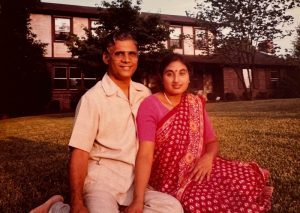
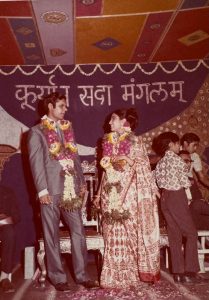
Both had studied English in India, so language was not a barrier when they moved to the US. Versha adds, “Education was always very, very important in our society and culture because it is our future.” However, the move did require sacrifice. “When I came to the U.S., I left everything behind. I was told to wear my heavy wedding dress on the plane. What made it even more challenging was that I had to wear all my jewelry too. Jewelry was kind of like a dowry, something a woman could sell for money if hardship occurred,” says Versha.
Versha’s brother also moved to the US and settled in Chicago at about the same time. Pravin met his new brother-in-law for the first time during a visit there. During the visit, Versha’s brother suggested they go out for pizza. She didn’t know what that was — she had always been a vegetarian. “They told me a pizza was like a dried-tomato dish. When the pizza came, I saw something that didn’t look like a tomato. It was a pepperoni! I guess the prank was on me!”
“A major difference in growing up in a middle-class family in India was that we learned to save and conserve everything from water to heat. We even soaked shades in water to help create a cool place to live. Sharing food before you ate yourself was essential. I was proud to keep that cultural traditional alive here at Southminster by cooking all the food for an Indian party.” She goes on to say that she and Pravin believe the move to the US was a blessing. “We have visited many countries and believe that the USA is the best. We have been US citizens now for over 45 years, and we have worked hard to make our dreams come true. We are blessed by God to be here.”
Saudi Arabia: Violeta Powell
Violeta Powell was born in Chile, but came to study in the U.S., got married and 14 years later, moved to Saudia Arabia. She and her husband John lived there during the Gulf War with the military airport literally in their own backyard. They both worked for an oil company, and she did not have a problem getting respect at work. However, the challenges of living in a Middle Eastern society for the next 22 years were “greater than you can imagine, in terms of culture and being a woman viewed as a 2nd class citizen. It was difficult to know what was right and what was not right. I had to be very careful what I said, what I did, and what I wore, including not wearing my cross.”
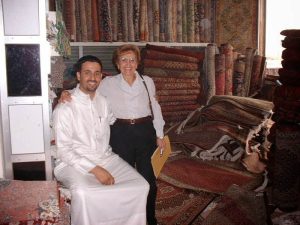
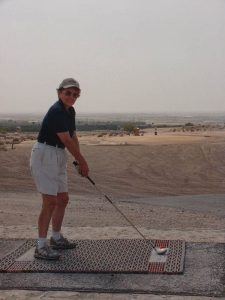
The experience proved to her that you can adjust to anything in your life. “Our children were 7 and 10, and we had a lot of workers from India, Pakistan and Sri Lanka, which gave our children a chance to learn to respect other nationalities. They also learned to appreciate food. If we heard that the commissary had gotten cream cheese or chocolate chips to make cookies, they would run to get it. That taught us not to complain or be picky. The experience of being with people from other countries is invaluable in anyone’s life.”
Spain and Germany: Beth McOwen
Beth McOwen’s “Living Abroad” experience came from marrying “very young” to a West Pointer. “He went right to Europe and had a very interesting job, so I got to travel a lot—mostly in Spain, but also in and around Germany. I knew nothing, but a I hung around with a guy who did a lot.”
Her husband was with the CID (Criminal Investigative Division), which was centralized at a major Army command responsible for a specific geographic area or “theater” where military operations were conducted following World War II. “Most people don’t know this, but in the late 50s, they needed to put long-range bombers in Europe. Italy was too bombed out, and France wouldn’t have us, so they put them in Spain. They built a huge airport, Torrejón Air Base, now the Madrid Airport. To build the airport they first had to rebuild the shipyard in Barcelona and then build the roads leading to the south of Madrid. They also set up chemical clearing/poison investigation in Zaragoza, where they would run tests on dead chickens from all over to see if they were killed by chemicals in the air.”
To get to a wide variety of places when she and her husband lived in Germany during the Berlin crisis, they had a big, white Chevrolet convertible. Her husband would be picked up, leaving her in the apartment by herself. “Wives like me were given a plan of escape if there was an invasion. I was supposed to get in the car with two 10-gallon cans of extra gas and food and drive to France. “I figured that since I was in a white Chevy convertible, I’d be the first one they would shoot,” she joked.
When her husband volunteered to go to Vietnam, she went back to the states. “My mother was overjoyed that I was getting out of Germany during the Cold War, but I got back to Delray Beach, Florida just in time for the Cuban Missile Crisis. We couldn’t get out of our development because of all the Army trucks going down to The Keys. After all those experiences in Spain and Germany, I was ready for anything!”
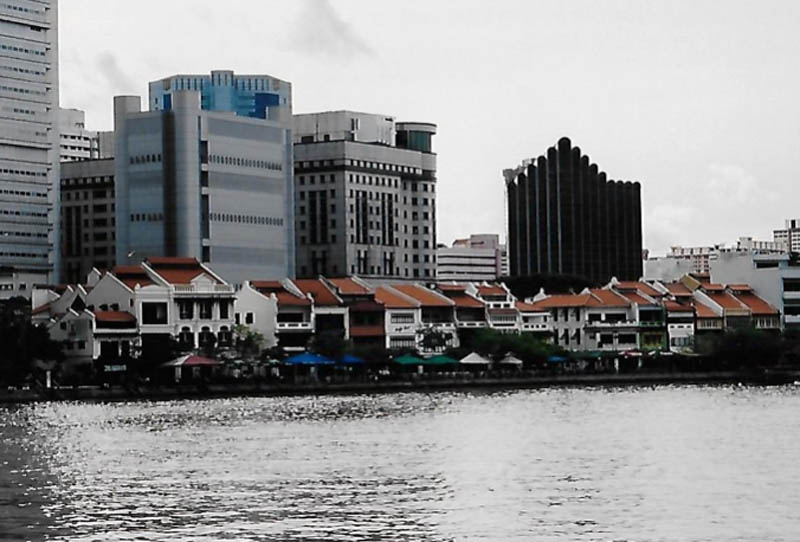
Hong Kong, Brussels and Singapore: Mary and Nelson Furman
Mary Furman tells people that if they ever need to pack anything to move, just let her know. In addition to living abroad, she and her husband Nelson have lived in seven states, four times in Delaware. “Hong Kong was easy because the British were there, and English was spoken in areas we went to. I was at home because in order to work, you had to have a profession they needed, or you planned to start a business and hire locals to work for you,” she said.
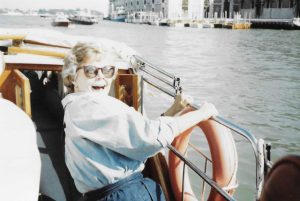
The move to Hong Kong was the most exciting for us as it was first. Nelson worked for DuPont, and the company sent both him and Mary to the University of Colorado Boulder for tutoring to learn about the different cultures they’d be living in and how to learn from them. “Knowing the ways things were done differently from the American way we were used to saved us a lot of embarrassment,” he said. “Mary was being taught how to live and run a house because I was gone all the time, travelling the whole region from Japan and China to Australia, Korea and Thailand.”
Mary adds, “Since I was home more than he was, I was all about trying new things, meeting new people, and seeing sights I’d never seen before. Since we didn’t have kids, in all three locations we chose not to live in the area with most of the American expats, typically near the American school. We wanted to experience life more like the locals rather than recreate America abroad.”
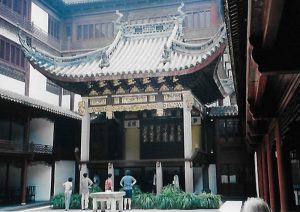
Nelson remembered being so excited to be there when they first arrived. “But when we moved from the nice hotel we were staying in while we waited for our apartment to be ready, we realized we were not on vacation anymore! Our first dining table was an appliance box, and we needed dehumidifiers in every room.” One thing Mary remembers distinctly was when cell phones appeared. Restaurants had signs that read, “No cell phones.” They were too big and took up too much space.
Mary said going overseas made her grow up very fast. “You have to go with an attitude to accept the differences and work with people.” Nelson said when he was in school there was a lot of emphasis on planning – what do you want to be doing five years from now? “I didn’t have a plan, except to stay out of Vietnam, which DuPont promised they would do, so I was willing to play it by ear. We had an interesting and exciting life, and I worked in over 40 countries we didn’t live in. I got to see how the rest of the world looks at America. The view of us is good or bad depending on where you are.”

During a merger in 1999, Nelson accepted a buyout to retire at age 56, but he was subsequently asked to go back to Asia for two years. “As soon as I asked Mary, her immediate response was ‘Let’s go.’”