


Disabilities Become Capabilities in Living Life with Purpose
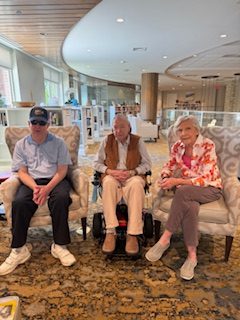 When you get together with a group of Southminster residents who have aging-related health challenges, the last thing they seem to want to talk about is what some people might call their disabilities. Instead, the joy of living, laughter, and all the many capabilities and interests they can put to use at Southminster drive the conversation.
Gray Carrington, a native Charlottean who has been blind since birth, has always made the most of life. Living at Southminster has put him a position to live as fully as ever before. In addition to performing music and making every day as active as he can, he thrives on volunteering, something he’s done at Southminster since long before he became a resident.
Janet Haack, a proud daughter of the Midwest who grew up in Michigan, adds that she thinks Carrington’s superpower is that he tells the best jokes. Haack, who has macular degeneration, clearly has a sense of humor of her own. She says she does NOT volunteer like Carrington because that would be a health hazard to the person she was trying to help.
Haack’s rich life experience, mining diamonds in South America at a young age, living out of the country for 20 years, and owning Donald Haack Diamonds in Charlotte with her late husband gave her many strategies for managing and coping with being almost totally blind now, a progression that happened over three years after she came to Southminster.
Today, the 92-year-old says she does everything through feeling and hearing instead of sight. Audible and Libby are excellent resources for listening to books, and she sings the praises of the Metrolina Association for the Blind, an excellent organization always in need of volunteers. “I also signed up for the New York Times, and even though I’m not a techie, I use the Internet with help from my children.”
Closs Gilmer, who grew up in Elizabeth City, N.C., is a former teacher who moved to a career in manufacturing and was later an elementary school volunteer working with disadvantaged children. A Southminster resident for eight years, she has found exceptional strategies for dealing with her Parkinson’s Disease through Memory & Movement Charlotte. “When I realized I had Parkinson’s, I couldn’t take the medications available and had to begin using a walker and a cane. It had also become hard to write my name. New meds came on the market that made a huge difference. Now I have four exercise and therapy sessions a week and do voice work. Exercise, activity and attitude are key, and Southminster makes all of that readily accessible. I love it so much.” She also volunteers on several committees since she is drawn to learning about how things work.
Over the past 14 years, Dick Welch, who was born in western Massachusetts, has found Southminster to be the perfect second act to his long international career with IBM World Trade. “We lived in Japan, New Zealand, France, Australia, and, at one point another foreign country—Connecticut and New York State,” he jokes. “A year-and-a-half after I got here in 2010, I was asked to join the Southminster operating board as Vice Mayor, then served two terms as Mayor. Next, I was on the actual Board of Directors, and served on the Healthcare, Budget and Maintenance Committees.” Welch also demonstrates his sense of humor and zest for life when he says he couldn’t “stomach” being on the Food Committee.
A Legacy of Southern Hospitality
“You know what this place is about the day you walk in,” said Chad Jordan, one of the owners of Collective Therapy, which offers on-site therapy services to residents and employees at Southminster. “It’s a wonderful culture with a feeling of community, old-school hospitality and etiquette, filled with unlimited acts of common courtesy. We all do things for each other. That devotion sets the basis for everything that happens here.”
Carrington moved to Southminster because his mother didn’t want to come here by herself. “I think Southminster serves as an inspiration to a lot of places. We love it here because no one is ever left out. If you need something, you just ask for it, and before you know it, you’ve got it! They always come through. Other organizations could learn from Southminster. Here, you find that the more you do, the more you can continue to do and grow.”
“I think the character of Southminster started way back with the group that founded it. The best way to describe it,” Welch said,” is that it was founded as a village. “That’s why we have a mayor and not a president. The sense of sharing and community comes from never being turned down if you step up.”
Being associated with NorCCRA, a statewide volunteer non-profit organization of residents living in continuing care retirement and life plan communities, makes a big difference too. Right now, there are only 39, but more have applications into the Board of Insurance Commissioners. “Southminster has a very interesting business case,” Welch continued. “We are an independent that needs no sign-off from a higher authority.” Gilmer also attributed the unique character of Southminster to the efforts of former Southminster CEO David Lacy. He was a wonderful man who believed in the idea that Southminster would take care of our residents, no matter what.”
Palatable Resilience
What would members of this group say to someone who might want to move to Southminster? “It really is a sense of community. We’re all waiting for you with open arms,” Haack said, “but you need to get on the list –do it now.”
Jordan seconded that emotion. “From a therapy perspective when I’m out in the community, my advice is to get there as soon as you can, and I generally recommend doing it a year early than a day late. The point is to get over here, establish a social group, and get involved in activities. That sets the precedent for leading a longer, happier, more productive life.”
Another point is that when you lose a spouse or friend, you get a great opportunity to find immediate support here—you don’t get a chance to grieve. “Because of that extremely supportive group concept here,” Welch said, “I sometimes feel like I am not grieving enough over the death of my wife. I have so many friends to step in and fill the void. After Barb died, I happened to be in Embrace, and when I went back to the apartment for three days, I screwed up so many things. At one point, I baked some muffins, but they just crumbled in my hands. I had to laugh!”
Some seniors think they want to age in place, but that’s not the best strategy for learning and growing. As Southminster Communications and PR Manager, Susanne Shaw said, “Even if you develop health challenges, there’s so much opportunity for new growth, new things to try and new people to meet. That’s part of what makes this an engaging place to live and be happy. In my 11 years here, the take-away for me has been that this generation of residents has been through so many exciting, traumatic, terrible, wonderful things that make them tough, resilient and supportive. If you think the advent of COVID was a tough challenge in your life, remember that people here have been through World War II.”